Emissions
Why does my semi go into derate in cold weather? DEF, regens and sensors
Frozen DEF, failed regens from idling and cold-soaked sensors are the usual reasons a truck derates in winter. What to check, what the 2025 EPA derate changes mean, and when to get it diagnosed.
· 6 min read · Atoka Tire & Service
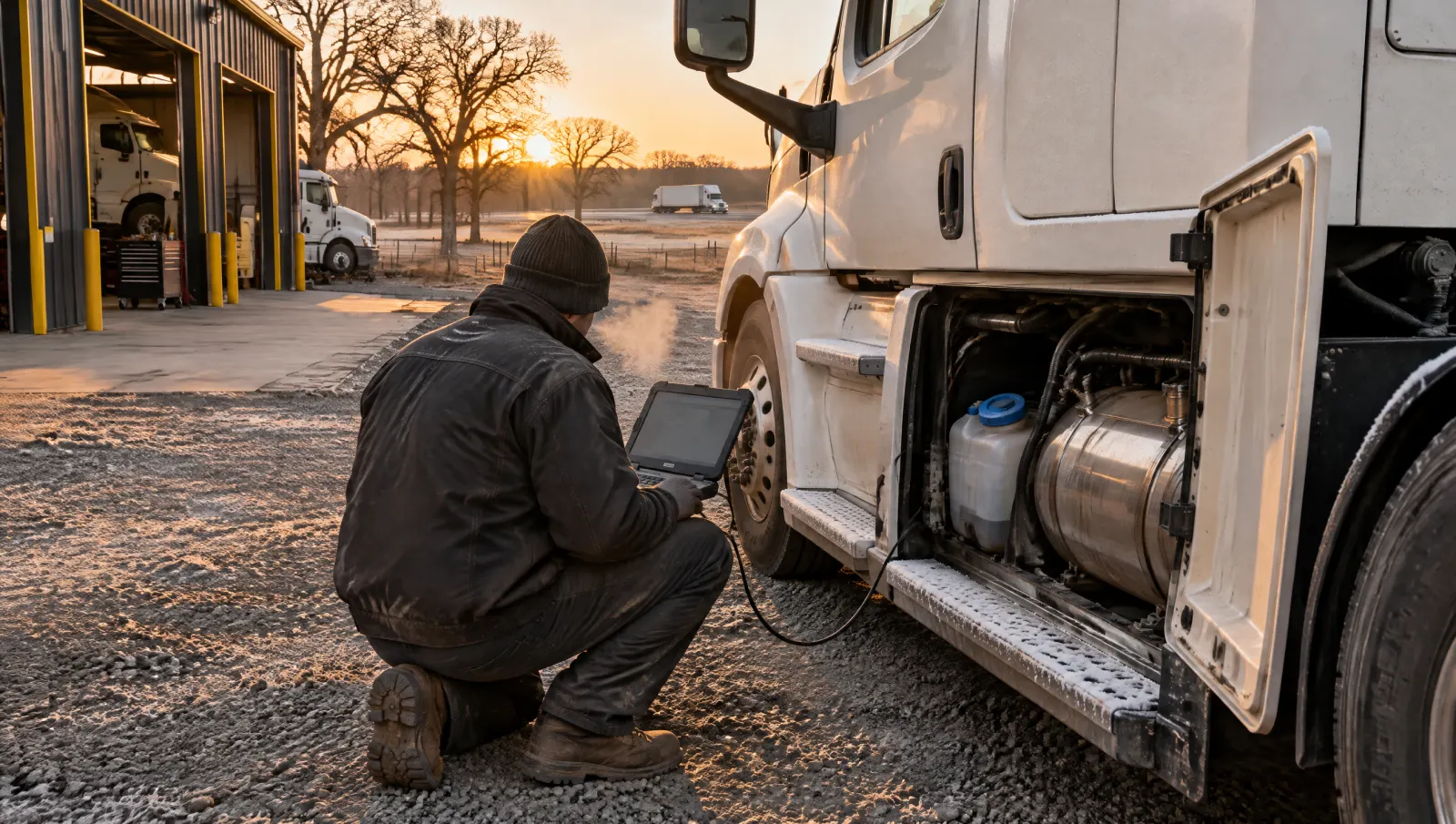
A semi usually goes into derate in cold weather because the emissions system can't do its job: DEF froze or its heater failed, the DPF loaded up from idling and couldn't finish a regen, or a NOx or temperature sensor gave a bad reading. Atoka Tire & Service in Atoka, Oklahoma, sees all three once the first hard freeze hits US-69.
Derate means the engine computer cuts your power, your speed, or both, to protect the emissions system or to force you to fix it. It is not the truck being dramatic. It is the truck telling you something upstream quit.
What does DEF have to do with cold weather?
DEF freezes at 12°F. Diesel exhaust fluid is 32.5% urea mixed with deionized water, and the water part freezes long before your diesel ever thinks about gelling.
Trucks are built for this. The DEF tank and lines have electric heaters that thaw the fluid after a cold start, and the system is allowed some time to get there. Freezing itself doesn't ruin DEF either. Thawed DEF works fine.
The trouble starts when a heater has quietly failed. Then the tank stays a block of ice, the doser can't pump, and the truck logs a fault. Penske's maintenance team calls frozen tanks and lines "a common source of delays" every winter and says to confirm tank heaters work before cold weather, not during it (Penske, 2025).
A few habits help:
- Don't top off the DEF tank to the brim right before a deep freeze. Frozen DEF expands and needs room.
- Never add anything to DEF to "winterize" it. No anti-gel, no alcohol, no additives. That's a contamination fault waiting to happen.
- Keep jugs inside the cab or a heated space, not in a side box in January.
Why does idling make regens fail in winter?
Idling and short runs keep the exhaust too cool to burn soot off the DPF. The DPF (diesel particulate filter) traps soot and cleans itself by burning it off, which is called a regen. Passive regens happen on their own at highway load. When the exhaust stays cold, the soot just piles up.
In winter, a lot of drivers idle for heat during a 10-hour break. That's understandable. It's also how you end up with a "regen required" light the next morning, then a forced regen you didn't plan for, then a derate if you ignore it. Penske notes a forced regen can take up to 45 minutes, and trucks that idle a lot may need filter cleaning more often in cold months.
If your truck asks for a parked regen, do it. Stopping one halfway, over and over, is how a filter goes from "needs a regen" to "needs to come off the truck."
Which sensors fail when it gets cold?
NOx sensors and exhaust temperature sensors are the usual suspects. Cold, moisture and road salt all work on their wiring and connectors. A sensor that reads wrong can make the computer think the SCR system (the part that uses DEF to clean NOx out of the exhaust) isn't working, even when it is.
What we see on the job: the code points at one part, but the cause sits one step upstream. A NOx code can come from a bad sensor, a weak DEF doser, poor DEF quality, or an exhaust leak ahead of the sensor. Swapping the sensor first is the expensive way to find out it wasn't the sensor.
Weak batteries make all of this worse. DEF heaters and pumps pull real current on a cold start, and a tired battery bank can leave them short.
How fast does a DEF derate kick in now?
It depends on your truck's software. Until recently, a DEF fault could take a heavy truck down to 5 mph within about four hours. In August 2025 the EPA issued guidance asking manufacturers to stretch that out (EPA fact sheet, 2025).
For heavy-duty trucks, the new schedule looks like this:
| Stage | When it starts | What happens |
|---|---|---|
| Old rule | About 4 hours after a DEF fault | Speed limited to 5 mph |
| Initial | 650 miles or 10 hours | 15% torque reduction |
| Secondary | 4,200 miles or 80 hours | 30% torque reduction |
| Final | 8,400 miles or 160 hours | Speed limited to 25 mph |
Two catches. First, existing trucks only get the new schedule once the manufacturer pushes a software update, and some of those updates can be done over the air while others need a shop visit. Second, starting with model year 2027, new trucks have to be built to avoid sudden, severe power loss after running out of DEF. In February 2026 the EPA said it is also reviewing whether derates are needed at all (EPA news release, 2026).
So don't assume your truck has the gentle version. Ask your dealer or check your last software update.
What should you do when the derate light comes on?
Get off the road somewhere safe, then work the problem in order:
- Note every warning light and message on the dash. Take a photo.
- Check the DEF gauge. Low DEF is the cheapest fix there is.
- If it's well below freezing, give the DEF heaters time to thaw the tank, then see if the fault clears. If it comes right back, suspect the heater.
- If the dash asks for a parked regen and you're somewhere safe, run it and let it finish.
- If the light stays on or the truck stays slow, read the fault codes before anyone replaces parts.
- If you can't keep moving, call for a tow instead of limping 40 miles on the shoulder.
Clearing codes without fixing the cause just resets the clock. The derate comes back, usually at a worse time.
Getting it fixed in Atoka
Atoka sits where US-69 meets US-75, between Dallas and McAlester. A lot of the trucks on this corridor in December came down from colder country overnight, and a DEF heater fault can start hundreds of miles before the derate does.
Atoka Tire & Service does DPF, SCR, DEF and EGR diagnostics on semi trucks. Our emissions service covers DEF pump and dosing problems, NOx sensor faults, DEF heater issues and failed regens. Diagnostics are a flat $275, quoted up front, and we tell you what it'll take before we start.
Can't drive it in? We can arrange a tow through Jim Mullins Towing, and emergency drop-off is open 24/7. If you need to wait on a part, we have truck parking on the same lot. See our full list of shop services too.
Want us to take a look?
Send us the codes or a photo of the dash and we'll tell you whether it's DEF, the DPF or a sensor. Book a slot online or call 580-262-8221.
Frequently asked questions
At what temperature does DEF freeze?
Diesel exhaust fluid freezes at 12°F (-11°C). Trucks have tank and line heaters that thaw it after a cold start, and freezing doesn't damage the fluid. If DEF stays frozen and the truck throws a fault, the heater is the first thing to check.
Can I add anything to DEF to stop it freezing?
No. DEF must stay pure 32.5% urea and deionized water. Anti-gel, alcohol or any other additive contaminates it and can damage the SCR system and set off more faults. Keep spare jugs somewhere warm instead.
Will my truck still drop to 5 mph if the DEF system faults?
It depends on the software in your truck. EPA guidance from August 2025 asks manufacturers to replace the old four-hour, 5 mph derate with a staged schedule that ends at 25 mph after 8,400 miles or 160 hours. Existing trucks only get it after a software update from the manufacturer.
Why does my truck keep asking for a regen in winter?
Long idling and short runs keep the exhaust too cool for passive regens, so soot builds up in the DPF faster. Let parked regens finish when the truck asks for them, and get more highway miles in when you can. If regens come too often, have the cause diagnosed.
Can clearing the fault codes fix a derate?
Clearing codes can restore power for a while, but the derate comes back if the cause is still there. The fix is finding why the fault set, whether that's DEF level or quality, a failed heater, a plugged DPF or a bad sensor.
Where can I get a derate diagnosed near Atoka, Oklahoma?
Atoka Tire & Service at 828 13th St in Atoka, where US-69 meets US-75, diagnoses DPF, SCR, DEF and EGR problems on semi trucks for a flat $275 diagnostic fee. Call 580-262-8221 or book online, and emergency drop-off is open 24/7.